Blog: Secrets from the Chef
Quick review of Wacom Cintiq 21UX Intuos 4

One of the goals I had for the visit to the recent Creativefuture 2010 conference was a “conversation” with the outstanding new Wacom Cintiq pad. Each professional is very careful about his working tools, therefore I went straight to the Wacom’s stand. There was a thick crowd of curious people and I had very limited time for the test drive – others were lining up behind me. I waited diligently in the line and started the “tasting” process.
I picked Cintiq 21UX Intuos4. Why going cheap? :)
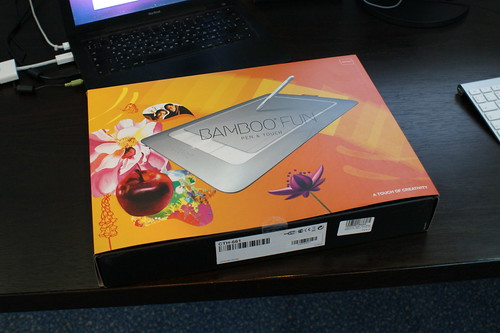
Wacom Bamboo Fun M Pen&Touch
Nearly every computer in our company has a graphics tablet connected to it. This fact is easy to explain, since we are all designers. Today yet another “pet” was adopted by our office: Wacom Bamboo Fun M Pen&Touch. I want to take this chance to share my personal impressions on this tablet.
Looking for an alternative to Basecamp: review of PBworks Project Edition
 Strictly speaking, Basecamp should not be regarded as a project management tool. Even its developers agree to this. “Basecamp is the leading web-based project collaboration tool”—says the official site of this highly respected program in large font. Basecamp is a communication tool. It is alternative to emails. Basecamp will not be able to measure the work load for the whole team nor for each member individually. Basecamp is also unable to evaluate the realism of set deadlines. Instead, it simply helps us at exchanging the required information inside a team and with our clients.
Hooking up two monitors to Macbook or turning an old iMac into a Firewire monitor
 I do graphic design on a notebook. This is hustle-free if you hook up your notebook to a 24-inch screen. But once I realized that one big screen was not enough. I wanted yet another monitor. But my notebook is equipped with just one monitor extension port and external video cards for macs are rather rare. So it happens that I found a deserted iMac G5 with a 20-inch screen in our office. I have fiddled with the hardware a bit and came up with the following kind of desktop:
Five reasons for migrating to the new Illustrator CS4
 All new stuff is extremely lucrative: it lures a feeling of novelty and freshness. I sincerely believe that a newer version is always better than the previous one. But there is one software package that undermines my life views. I am talking about Adobe Illustrator. It gained so many useless functions that operational mistakes have become too easy to see. It all lasted for six passed years. Here is an appropriate time for a short sermon.
WorkSection Review
 We have been using Basecamp (web-based project management and collaboration tool developed by 37signals) for many years. I will not be able to truly emphasize on how important this tool is for us since our clients are scattered around the Globe and all communication with them is handled online.
For small service IT companies like ours, Basecamp became a de-facto standard. On one hand it is very convenient: new users recently invited into our cozy Extranet have no problem getting around. On the other hand, we get the feeling that Basecamp is “too tight”. And it is not surprising: you cannot please everyone and the guys from 37signals are well aware of that and not even trying.
My GTD experience: emptying my inbox with GTDInbox
It was a year and a half ago, my head brimming with ideas about GTD, when I realized that an efficient system of self-organization based on the principles of GTD would make most sense if built around the email client; simply because the vast majority of incoming material requiring attention is delivered via email.
Tools: Chapter 2, the raster-based one
You are probably beginning to boil over — it’s been three weeks since Dmitry revealed the mysteries of the vector stage of icon creation, so where is that continuation? Let me tell you why we made no haste.
The thing here is that we always try to cut down on this raster stage as much as possible. We take pains to dally that moment when we minimize Illustrator and launch Photoshop. I wish I’d never see that Photoshop! Where do I get that hatred to all designers’ holy cow? It’s nothing personal, I assure you. There is nothing bad I can say about Adobe Photoshop as a specimen of the class of raster editors, let alone the fact that it is crafted with more quality that our beloved vector-based Illustrator. My dislike lies not for the specific product but for all methods to edit an image whilst they are based on their raster output.
Tools: Chapter 1, the vector-based one
 At the dawning of my creative career the one and only vector-based drawing program was Corel Draw. I didn’t even care to think there were any other. Corel Draw was perfect until you had to rasterize your work. It was the worst I have ever seen in my life. To import your work in Photoshop, you had to save the vector in the EPS format, which is alien to Corel and kin to Adobe, losing some effects at the time.
Thus, my acquaintance with Adobe Illustrator was the result of despair. Yegor, he is a true martyr. He went through Corel Draw, Xara and Macromedia Fireworks, and he had yet a lot to suffer, hadn’t he chosen Adobe Illustrator. And it was only Denis the smart boy, who decided to master the vector-based thing by Adobe and even bought a book on the subject.
I’m saying all this to let you know that Adobe Illustrator is not the choice dictated by our ideology, as some might think; it is the only tool suitable for making vector-based icons. Had we the opportunity, we’d eagerly change it for something else. Illustrator would have won the first prize in the contest for the worst and most carelessly written $500-priced program. The quantity of errors stuns your mind and sometimes makes you just livid. Well, let’s not go too deep in the sad thoughts…
Tools: Introduction
Once upon a time we received a letter from Mr. Anton Tretyakov (Internet). He asked the following (we retain the original spelling and punctuation):
“Hello! Tell please in what programs I can bigin making icons. I am a designer and know basic graphic programs. I am interested in the steps of drawing.”
That’s one strange question, isn’t it? One should have looked a bit deeper and read our wonderful blog. It would have become clear that we are using Adobe Illustrator and Adobe Photoshop. Of course, we didn’t get upset with Anton’s paying little attention to our work: his letter let us furnish our blog with a series of articles about the tools we are using.
What could outrank Basecamp?
There is hardly ever a person who could be surprised by a convenient and nice extranet system. “Oh! You are using Basecamp! Great!” — that is what our clients tell us after they have received an invitation to visit turbomilk.seework.com. Basecamp has become a de facto standard, and 37signals, its developers, showed up as recognized gurus of web applications design and usability.
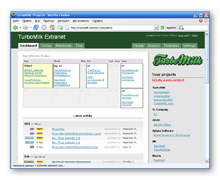 When we started using Basecamp, it felt like we are in heaven. The system simply did its job without making us think that we are too dumb to use it. A complete absence of tweaking options (except coloring the interface) turned out to be a great advantage of no necessity to spend the time and efforts to do that tweaking. Just launch — and work. However, after a year of active use of Basecamp (several dozens of accomplished projects later) I started to think we need to take a more sober look at this system.
Swift 3D
I should confess of being skeptical as to 3D modeling in icon design. Really, on the 32×32 or even 48×48 scales these technologies have no room to swing a cat. Simple objects are easy to draw without modeling and complex objects will be a mess anyway. Slight mistakes in perspective building are not critical, whereas it is more important to match the lines with the pixel grid which is done only manually. Shades and highlights will look better in such a limited space if a skilled hand does that instead of a machine — and not at the expense of the result!
But times, they are changing.
Inkscape

Many are already aware of the cunning evil Linux users having devised a way to use vector-based icons in the GUI… What will they use to create them? Now that’s a good question! They started making their own vector-based drawing program. Linuxoids are strange, but nice and generous people. No wonder their editing program is platform-independent and free. It is called Inkscape.
As a matter of fact, this icon — the logotype of Inkscape was created with this program.
What now? Inquisitive minds go to the official web site and download the version for their platform (the Mac OS version is about 14Mb, and about 8MB for Windows) and then try to create something. All the rest go on reading.
A Glance at Microsoft Expression
Why did I pay attention to this product? According to Microsoft’s idea, the Expression family of products is intended to satisfy the needs of interface designers for Windows and for web. Thus, Expression Graphic Designer (MSEGD) is to be the first tool specifically intended for designing interface graphics (except Flash, but Flash has a much more limited scope of application).
Its “brother” is the Interactive Designer, which is promised to fulfil the eternal dream of interface designers, that is, to create interfaces without the programmers’ involvement (do not mix it with RAD Tools. It had quite different objectives).
Breathtaking prospects. Launching the program…
Categories
- Adobe Illustrator (15)
- Adobe Photoshop (4)
- Basecamp (3)
- Books (3)
- Case Studies (11)
- Criticism (6)
- Desktop (2)
- Fundamentals (8)
- Future (3)
- Icon design (25)
- iPhone (2)
- Marketing (1)
- Master-class (20)
- Productivity (3)
- Reviews (13)
- Tools (14)
- Turbomilk (2)
- Usability (7)
- Visual style (4)
Popular
- cookbook10 Mistakes in Icon Design
- cookbookPhysics still matter, even with special effects
- cookbookWhy the new Google favicon is bad
- cookbookThese could be the new LiveJournal’s icons
- journalWe have moved into a new office
- cookbookFive reasons for migrating to the new Illustrator CS4
- journalSpring background for LiveJournal
- journalFree icons for Livejournal
- journalUpdates to “About us”
- cookbookLooking for an alternative to Basecamp: review of PBworks Project Edition
journalWe have moved into a new officedocornfordorlan: rs avoid workouts in non-breathable clothes, and to stop exercising within the next very incredibly hot or humid.Wearing light-colored, loose installing clothing helps in dissipating warm during activity. Denim is perfectly for pregnancy given it keeps one cool inside summer as well as warm in the cooler a long time.Denim is supplied in many variations, and might be worn in a considerable amount of different means.You could dress deeper jeans together more, which are the most versatile expectant mothers fashion staples.Seven for everybody Mankind expectant mothers jeans can be a very favorite and elegant option.A well-fitting two of black pants is usually a will need to, because you'll be able to dress thers avoid workouts in non-breathable clothes, and to stop exercising within the next very incredibly hot or humid.Wearing light-colored, loose installing clothing helps in dissipating warm during activity. Denim is perfectly for pregnancy given it keeps one cool inside summer as well as warm in the cooler a long time.Denim is supplied in many variations, and might be worn in a considerable amount of different means.You could dress deeper jeans together more, which are the most versatile expectant mothers fashion staples.Seven for everybody Mankind expectant mothers jeans can be a very favorite and elegant option.A well-fitting two of black pants is usually a will need to, because you'll be able to dress these people up and down. Dressmaker Liz Lange advises women that are pregnant to keep with the same form of things individuals wear when ever they're not really pregnant.Maternity clothes are generally costly, particularly if you think that you'll wear them for just one or two short several weeks.So study your closet for ones clothes that you just tend for you to wear when you're a small heavier than normal.Even your selected jeans will be able to last one or two extra months the use of a minor ingenuity. For the purpose of work, get yourself a jacket, cover, pants and wear the similar quality, flexible fabric, in basic tones along the lines of black, overcast, navy as well as tan.A vivid shirt or maybe blouse (in summer) and then a sweater fixed (in winter) will brighten your clothing.For the feet, pick an appropriate sling-back cylinder or a sophisticated flat in a larger girth than customary to let feet breathe.Neckties, necklaces, charms, and other accessories can certainly add personality for a outfit. This strategy will assist you look good in a season:flaunt your current features.If you have had nice lower limbs, wear the sundress.For anyone proud of your respective pregnancy cleavage, show the idea off accompanied by a low-cut blouse.Maternity outfits have gotten more trendy, and today we've got a broad selection of clothes, because of business, towards formal don, and perhaps maternity corset lingerie.
articlesFive reasons for migrating to the new Illustrator CS4dobrowskrola: te you add coffee as well as alcohol to the equation.Drink mineral water or even plain water rather then coca diet coke, tea and other choices. Approach #5 Ignore The Bread Most restaurants bring baskets loaded with bead with the table.This blog is a no-brainer.Purely don't consume the bread.If you're at an easy food avenue, then you are able to eliminate calories by getting your fried chicken open faced.Simply take away the top portion of the bun and discard it again. Strategy #6 Stay clear of Fried Foods. When examining a menu stay clear of anything that is frite you add coffee as well as alcohol to the equation.Drink mineral water or even plain water rather then coca diet coke, tea and other choices. Approach #5 Ignore The Bread Most restaurants bring baskets loaded with bead with the table.This blog is a no-brainer.Purely don't consume the bread.If you're at an easy food avenue, then you are able to eliminate calories by getting your fried chicken open faced.Simply take away the top portion of the bun and discard it again. Strategy #6 Stay clear of Fried Foods. When examining a menu stay clear of anything that is fried.Foods which might be baked, boiled, steamed and roasted are significantly better bets.If something is fried it's advisable if it's fried in olive oil or wines. Strategy #7 Bring the minimum Glycemic Snack For anyone who is have be familiar with busy lifestyle that hardly allows time for a proper meal you can avoid succumbing that will temptation at ready made meals joints through bringing the glycemic treat.A banana, peanut butter not to mention honey sub on whole grain bread is a great example of a low glycemic munch that quells appetite pains and can offer plenty of energy. Approach #8 Procedure H.SOME SORT OF.L.TESTOSTERONE LEVELS. THEY WOULD.A.M.T.is short for used within addiction circles which means never get hold of Hungry, Mad, Lonely and Tired.Most urges and attacks of stuff yourself eating happen to be triggered by simply any a type of four circumstances. Determine what that you saw is making you Hungry, Mad, Lonely or possibly Tired after which think associated with ways that you could make changes to all your schedule or simply lifestyle to make certain that you won't have to eat on the run from the outset!
journalWe have moved into a new officedobrowskrola: ven outdoor cameras.If creating a security system designed to monitor the actual perimeter on your property, or is normally external to your house, then select the cellular cameras so cabling is very simple.Optionally just for external cellular cameras are small transmitter and receiver devices that will transform any specific wired camera suven outdoor cameras.If creating a security system designed to monitor the actual perimeter on your property, or is normally external to your house, then select the cellular cameras so cabling is very simple.Optionally just for external cellular cameras are small transmitter and receiver devices that will transform any specific wired camera suitable wireless 1.To review:start in your existing camcorders to leverage should never investment, or get started in small using purchasing 1 or 2 higher quality wireless cameras.Then determine a transmitter/receiver centralized appliance, this can possibly be attached to your existing wired or wireless router.Utilize the uplink port for your existing router if the necessary connections have been used.The benefits to come to be gained by simply this configuration are several.You may well monitor your own house or business without paying monthly fees.So for not a whole lot more than you've gotten already invested at home networking, you can piece associated with mind additionally.
journalWe have moved into a new officedobrowskrola: successfully multiplied for good sized cakes such as wedding cakes. Could you prefer a regular or some sort of contemporary wedding cake? Wedding party cakes customarily have several layers; are usually covered around hard white frosting; and have got a small plastic type of a wedding couple on very best.A cake with this sort, decorated by a professional cake designer, can search very wonderful.However, more cutting-edge brides are already choosing being married cake that is certainly more odd, in colors that range between one end in the rainbow to your other.One reasonable choice is always to match large of an individual's cake towards theme of your wedding.Despite the fact that cakes are generally traditionally often round or maybe square, a great many other shapes are possible, and also an asymmetrical style and design can look very stylish. How to pick a marriage cakesuccessfully multiplied for good sized cakes such as wedding cakes. Could you prefer a regular or some sort of contemporary wedding cake? Wedding party cakes customarily have several layers; are usually covered around hard white frosting; and have got a small plastic type of a wedding couple on very best.A cake with this sort, decorated by a professional cake designer, can search very wonderful.However, more cutting-edge brides are already choosing being married cake that is certainly more odd, in colors that range between one end in the rainbow to your other.One reasonable choice is always to match large of an individual's cake towards theme of your wedding.Despite the fact that cakes are generally traditionally often round or maybe square, a great many other shapes are possible, and also an asymmetrical style and design can look very stylish. How to pick a marriage cake designer The ultimate way to choose some sort of designer for your personal wedding torte is certainly through private recommendations.When you have friends who may have got committed recently were particularly excited about their big event cakes, those designers would have been a good starting point.Perhaps you do have a favorite local bakery, where you purchase muffins weekly for breakfast for a Sunday morning.Do in addition they design marriage cakes? Once you've a short directory designers -- potentially three -- help to make appointments to meet with everybody and to help you taste samples of their wedding ceremony cakes.Most manufacturers are delighted either to style a torte exclusively in your case, or to help recreate some sort of cake which you have admired.When you have already begun take into consideration the design of this wedding birthday cake, and you've got pictures connected with cakes for you to particularly like, be sure to use them to you. How big is your funds? Wedding cakes may be surprisingly high priced, with prices including $3-$15 each portion.There are ways you could economize against your wedding torte.One of the most extremely effective is to choose a wedding cake that is smaller than you should have and in order to supplement that along with a sheet cake within the same flavoring and design.Not sole is this likely to end up cheaper, but it can even be easier for ones caterer that will serve desert quickly plus efficiently as soon as cake dropping ceremony. The perfect wedding food designers are usually booked months before hand.If probable, you really should start an individual's planning about nine months prior to wedding, and order the wedding ceremony cake you finally choose at least a few months in boost.
articlesFive reasons for migrating to the new Illustrator CS4dobrowskrola: indoors for virtually every long timeframe.A good rule is to prevent it indoors for a few days every thirty days at maximum.Otherwise, the modified temperature plus environment will quickly damage any plant. Be able to water adequately.Since bonsai plants usually are small, it follows they may have a confined root product.Bonsai underlying issues systems usually are inadequate alone; it will involve human care that can help the put survive.Proper watering is usually an important component of raising bonsai.Again, it helps to know any type of plant you've gotten.Some variety of bonsai ought to be watered pretty much constantly; others might get by by means of minimum water.If you will water too often, you run raise the risk of offering fungal developindoors for virtually every long timeframe.A good rule is to prevent it indoors for a few days every thirty days at maximum.Otherwise, the modified temperature plus environment will quickly damage any plant. Be able to water adequately.Since bonsai plants usually are small, it follows they may have a confined root product.Bonsai underlying issues systems usually are inadequate alone; it will involve human care that can help the put survive.Proper watering is usually an important component of raising bonsai.Again, it helps to know any type of plant you've gotten.Some variety of bonsai ought to be watered pretty much constantly; others might get by by means of minimum water.If you will water too often, you run raise the risk of offering fungal development.On additional hand, dryness in addition to humidity can quickly kill some sort of plant in any other case monitored.To help water ones bonsai proficiently, you must understand numerous particularities within your plant. Repot properly.Repotting bonsai when you feel like it's not necessarily a great idea.Most bonsai tree plants will not hold upward well less than stressful situations - repotting involved.Bonsai plants tend to be root-pruned plus repotted annually, often while in springtime.Some group can relax in the same pot for two main years and you should watch your current plant carefully to check out if it requires repotting. Just as any other sorts of plant, you should beware of your bonsai plants health and wellbeing.Look just for dull limp leaves or simply leaves which might be turning yellow or darkish.Any the very first or growths within the leaves is a sign for disease.Hunt for little mites or possibly bugs that will infest ones plant.Keep your own bonsai clear of any several other plants that are fitted with virtually any infestation as well as disease.If you're more dedicated your bonsai will often have a illness, remove each of the diseased browsing leaves and even take the steps needed to make your plant back on the path to health. Bonsai vegetable care is never ever simple.Even so, it seriously isn't impossible to discover.By continuing for more info about ones plants and spending some time to refine your abilities, you can count on having your beautiful bonsai tree trees.